The inventory management to sales performance relationship becomes clear through inventory turnover ratio. Your business effectively sells and replaces its entire stock monthly when inventory turns over 12 times yearly . This metric stands out as a vital efficiency ratio because it shows how well companies employ their assets to drive revenue .
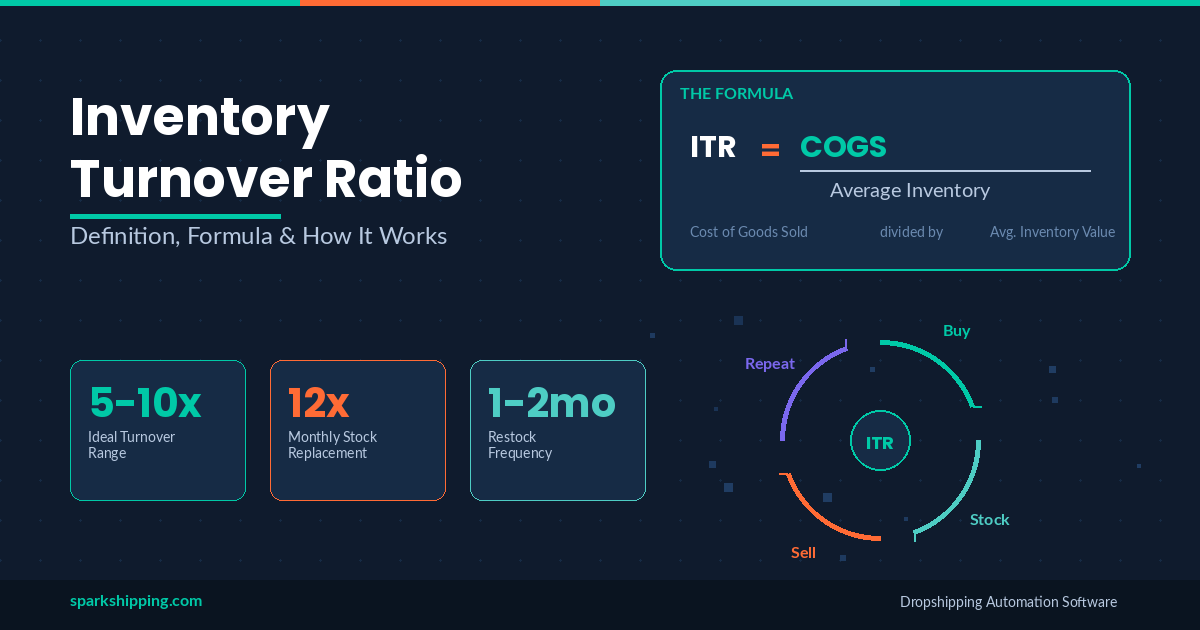
Managing inventory levels remains an ongoing challenge for businesses. Companies prefer a higher inventory turnover ratio because it demonstrates efficient inventory management without excess capital tied up in unsold goods. Most businesses aim to maintain their inventory turnover ratio between 5 and 10, which means they sell and restock inventory every 1-2 months . The "ideal" ratio changes substantially based on your industry and business model .
Let's explore the inventory turnover formula in this piece. You'll learn how to calculate inventory turnover accurately and understand what your ratio means for your business performance. We'll help you optimize this critical business metric, whether you're experiencing high turnover that signals strong sales or low turnover that suggests overstocking.
Inventory Turnover Ratio Definition and Purpose
"Inventory turnover is a crucial measurement for understanding how your business is performing. This metric can help you make more informed decisions regarding manufacturing, buying products, storing inventory, marketing, and selling goods to customers." — Inflow Inventory, Inventory management software company and educational resource provider
The inventory turnover ratio is a key financial metric that shows how many times a company sells and replaces its inventory in a specific period, usually a year [1]. This calculation gives a great way to get insights about how well a business runs and how efficient it is.
What inventory turnover measures in business
Inventory turnover shows how fast products move from warehouses to customers. This ratio tells you how quickly companies can turn their inventory investment back into cash [2]. A complete inventory turnover happens when a company sells its stock, taking into account any items they lose to damage or shrinkage [2].
This metric shows you:
-
How fast inventory moves through your business
-
If you're keeping too much stock compared to sales
-
If your inventory levels can meet customer demand
-
How well your purchasing decisions match market needs
The ratio is also a reliable way to measure product marketability and sales efficiency [2]. Companies can learn about their marketing strategy's success by watching this ratio. They can also figure out which products need different approaches to sell faster.
Why inventory turnover ratio matters for efficiency
Inventory turnover ratio is vital to running efficiently because it affects a company's financial health and how they use their resources. Higher ratios usually mean strong sales and good inventory management, which helps cut storage costs and boost profits [3].
Keeping track of this metric helps businesses make smart decisions about:
-
Pricing strategies - changing prices based on sales speed
-
Manufacturing plans - matching production to actual demand
-
Marketing initiatives - putting more effort into slow-selling products
-
Purchasing decisions - getting the right amounts at the right time
-
Warehouse management - using space better [2]
On top of that, it helps maintain the right inventory levels—not too much to tie up money, not too little to miss sales [1]. Investors use this ratio to review how well a company performs compared to others in the same industry [1].
Inventory turnover ratio vs. inventory turnover
People often use these terms interchangeably, but there's a difference between "inventory turnover ratio" and "inventory turnover." Inventory turnover is the time between buying an item and when it is sold [4]. It measures the complete cycle of buying and selling products.
The inventory turnover ratio is the math behind this process—you divide the cost of goods sold by the average inventory for that period [3]. This number shows how many times a company has sold and replaced its inventory during a specific timeframe.
Days sales of inventory (DSI) is a related but opposite metric that shows the average days needed to turn inventory into sales [1]. While inventory turnover tells you the yearly cycles through your business, DSI shows how many days items sit in inventory before selling.
Companies must balance these metrics based on their industry standards to manage inventory well. Businesses selling perishables or fast-changing products want higher turnover rates. Those dealing with durable or investment goods can work fine with lower rates [4].
Inventory Turnover Ratio Formula and Components
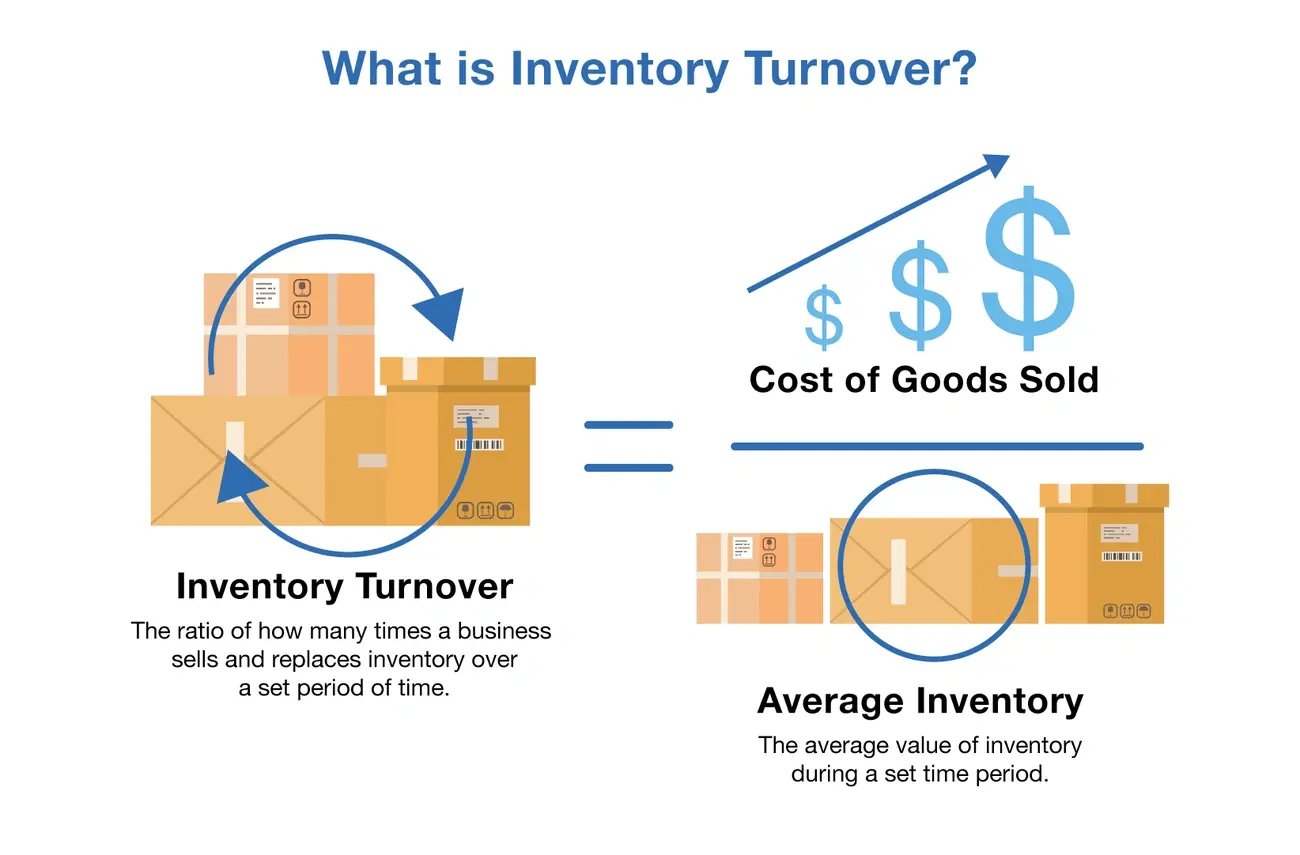
Image Source: BlueCart
You need two key components to calculate your inventory turnover ratio: cost of goods sold (COGS) and average inventory. Let's break down the formula and its elements to help you apply this metric to your business.
Inventory turnover ratio formula explained
The basic formula for the inventory turnover ratio divides the cost of goods sold by the average inventory for a matching period [5]:
Inventory Turnover Ratio = Cost of Goods Sold (COGS) ÷ Average Inventory
Analysts use COGS instead of sales figures because inventory values typically reflect cost, not the company's markup [6]. This method gives a more accurate picture of how quickly inventory moves through your business.
A quick example: Your inventory turnover ratio would be 5 if your annual COGS is $100,000 and your average inventory value is $20,000. This means you sell and replace your entire inventory five times yearly.
How to calculate average inventory
Average inventory gives you a clearer picture of your typical stock levels by smoothing out seasonal effects [6]. Here's the quickest way to calculate it:
Average Inventory = (Beginning Inventory + Ending Inventory) ÷ 2
To name just one example, see how a beginning inventory of $10,000 and ending inventory of $15,000 in January would give you an average inventory of $12,500 [7].
Businesses with heavy seasonal changes might need to use multiple data points throughout the period [8]. This approach works better:
Average Inventory = (Month 1 + Month 2 + Month 3 + ... + Month n) ÷ n
Where n represents the number of periods measured.
What is included in cost of goods sold (COGS)
COGS represents direct costs tied to producing goods during a specific period [9]. It only includes production-related costs, not general business expenses.
COGS typically has:
-
Direct materials - Raw materials and components that become part of the finished product
-
Direct labor - Wages for employees directly involved in production
-
Manufacturing overhead - Costs directly supporting the production process
-
Freight and shipping costs related to acquiring goods (not shipping to customers)
-
Packaging costs necessary to make products ready for sale [9][10]
COGS doesn't include general selling expenses like management salaries, advertising expenses, and other SG&A (selling, general and administrative) costs [11]. Here's a straightforward way to calculate COGS:
COGS = Beginning Inventory + Purchases During the Period – Ending Inventory [12]
This calculation shows the cost of inventory sold during your chosen period. Manufacturing businesses include material costs, direct labor, and manufacturing overhead in COGS. Retailers mainly count the cost of purchasing finished goods from suppliers [11].
These components help you calculate your inventory turnover ratio accurately and assess how well your business manages inventory resources.
Step-by-Step Inventory Turnover Calculation
Let me show you how to calculate inventory turnover ratio with clear examples. These alternatives will help you apply this metric to your business operations.
How to calculate inventory turnover ratio with example
The calculation of inventory turnover follows three simple steps:
-
Find your Cost of Goods Sold (COGS) - You'll find this figure on your income statement for your measurement period (monthly, quarterly, or yearly) [13].
-
Calculate Average Inventory - Add your beginning and ending inventory values for the period, then divide by two [13]:
Average Inventory = (Beginning Inventory + Ending Inventory) ÷ 2
-
Apply the formula - Divide COGS by Average Inventory [14]:
Inventory Turnover Ratio = COGS ÷ Average Inventory
To cite an instance, see this furniture retailer's case: They had quarterly COGS of $150,000. Their beginning inventory was $40,000 and ending inventory was $50,000, which gave an average inventory of $45,000. Their inventory turnover ratio came to $150,000 ÷ $45,000 = 3.33 [13]. This means they sold and replaced their inventory about three times that quarter.
Using COGS vs. sales in the formula
Some businesses use sales figures instead of COGS in the calculation, but this approach has its limits. Since inventory is typically valued at cost, using sales (which include markup) makes the resulting ratio look higher than it should [15].
This example makes the biggest problem clear: A company with sales of $800,000, COGS of $600,000, and average inventory of $200,000 would show these different results [15]:
-
Using COGS: $600,000 ÷ $200,000 = 3 times
-
Using sales: $800,000 ÷ $200,000 = 4 times
The sales-based calculation suggests faster inventory movement than what really happened. Dividing selling prices by costs creates a ratio that doesn't add up mathematically [15].
Inventory turnover calculator: when and how to use it
Automated inventory turnover calculators are the quickest way to monitor routine operations or complex inventory systems. These tools need the same basic information as manual calculations:
-
COGS for the period
-
Beginning and ending inventory values [16]
Most inventory management software has built-in turnover calculation features that let you:
-
Track turnover at product-level detail
-
Monitor seasonal variations
-
Compare performance across departments [17]
Businesses with multiple product lines can learn more by calculating turnover for each category separately instead of using one overall figure [18]. This helps identify which product lines move well and which ones need attention in inventory management.
How to Interpret Inventory Turnover Ratio
"A relatively low inventory turnover ratio may be a sign of weak sales or excess inventory, while a higher ratio signals strong sales but may also indicate inadequate inventory stocking." — Investopedia (cited by Acumatica), Leading financial education and investment resource
Your business's operational efficiency becomes clear when you understand what inventory turnover calculations mean. The numbers tell an important story about your bottom line.
What a high inventory turnover ratio means
A high inventory turnover ratio indicates your business manages inventory effectively. This helps cut storage costs and keeps holding expenses low [19]. Good sales performance and smart buying usually lead to this positive outcome [3]. That said, a very high ratio may indicate you don't have enough inventory. This can cause stockouts and missed sales opportunities [20]. Then businesses with sky-high turnover ratios might sell well but still go bankrupt if they don't make enough profit per sale [21].
What a low inventory turnover ratio shows
A low inventory turnover ratio indicates weak sales, excess inventory, or poor inventory management [19]. This increases holding costs, storage expenses, and the risk of inventory becoming outdated [21]. The extra inventory also ties up money that could help operations or marketing [3]. Companies with low turnover should review how many products they really need to meet customer demand [20].
Industry benchmarks for a good inventory turnover ratio
Each industry has its own standards that change based on product type, demand patterns, and business models:
-
Grocery/perishables: 14-18 times annually [3]
-
Consumer electronics: 8-15 times annually [22]
-
Home goods/furniture: 2.5-5 times annually [4]
-
Automotive parts: 15-20 times annually [22]
Most industries see a ratio between 5 and 10 as healthy. This means you sell and restock inventory every 1-2 months [21]. Whatever your industry, you'll learn the most by comparing yourself to direct competitors [23].
Inventory turnover vs. days sales of inventory (DSI)
Days' sales of inventory (DSI) provides another perspective by measuring how many days it takes to sell inventory [24]. DSI and inventory turnover move in opposite directions—when one increases, the other decreases [24]. The math is simple: DSI = (Average Inventory ÷ COGS) × 365 [23]. Inventory turnover tells you how often you sell, while DSI helps you see how long you hold stock. This makes DSI valuable for financial planning and finding slow-moving products [25].
Improving and Managing Inventory Turnover
A good balance between efficiency and availability helps optimize your inventory turnover ratio. Your bottom line takes a hit whether you're dealing with slow-moving stock or too much churn. Strategic changes can make a big difference.
Strategies to improve low inventory turnover
Companies with low inventory turnover need a full picture of their inventory management processes [20]. Here's how to boost this metric:
-
Update marketing plans to showcase products better
-
Look for new marketplaces to reach more customers
-
Keep prices competitive
-
Remove products that don't sell well
-
Use automation to simplify supply chain processes [20]
Risks of too high inventory turnover
High turnover sounds great, but can cause problems in daily operations. A very high ratio might show you don't have enough stock, which leads to:
-
Running out of stock too often
-
More unhappy customers
-
Breaking rules when rushing to restock [1]
-
Missing sales when supply chains fail [20]
Using inventory management software for optimization
Modern inventory management software helps you work smarter with these features:
-
Orders items automatically based on actual sales, not guesses
-
Sets up automatic triggers to avoid stockouts [1]
-
Works with enterprise resource planning (ERP) for better inventory control [2]
Forecasting and seasonal planning considerations
Good forecasting builds strong inventory management:
-
Look at past data, market changes, and seasonal patterns
-
Calculate basic demand from last month's sales or presales
-
Factor in changes like sales speed and supply chain issues [2]
-
Create different forecast models for various situations, including emergencies [2]
Conclusion
Becoming skilled at inventory turnover ratio reshapes how businesses handle their stock management strategies. This powerful metric shows the vital balance between inventory levels and sales performance. Your inventory turnover calculations help determine if capital gets efficiently allocated or stays tied up in excess stock.
The optimal inventory turnover varies by industry. Grocery stores aim for 14-18 turns annually, while furniture retailers do well with just 2.5-5 turns. Your performance compared to direct competitors provides more valuable insights than arbitrary standards.
The formula stays simple - divide your Cost of Goods Sold by your average inventory. The resulting number's implications go way beyond the reach and influence of basic math. A low ratio points to potential overstocking or weak sales. A very high ratio suggests insufficient inventory levels that could hurt customer satisfaction.
Companies need to analyze their inventory turnover data with days sales of inventory (DSI) to see their operational efficiency clearly. Modern inventory management software improves accuracy and enables evidence-based decisions instead of estimates.
Your business should take action when ratios fall outside ideal ranges. Low turnover might need revised marketing strategies, new sales channels, or adjusted pricing. Very high turnover could require better reordering processes to avoid stockouts.
The inventory turnover ratio works as a vital sign of your business's health. This metric helps balance competing needs of capital efficiency, product availability, and customer satisfaction when properly understood and optimized. It serves as a key tool to accelerate business growth.
Key Takeaways
Understanding and optimizing your inventory turnover ratio is essential for maintaining healthy cash flow and operational efficiency in any product-based business.
- Calculate turnover using COGS divided by average inventory - This formula reveals how many times you sell and replace stock annually, providing crucial insights into business efficiency.
- Industry benchmarks vary significantly - Grocery stores aim for 14-18 turns yearly while furniture retailers function well with 2.5-5 turns, making competitor comparison more valuable than arbitrary standards.
- Balance is critical for optimal performance - Low turnover signals overstocking and tied-up capital, while extremely high turnover risks stockouts and lost sales opportunities.
- Use complementary metrics for complete analysis - Combine inventory turnover with Days Sales of Inventory (DSI) to understand both frequency and timing of stock movement.
- Implement strategic improvements based on your ratio - Low turnover requires marketing adjustments and pricing reviews, while high turnover needs refined reordering processes to prevent stockouts.
For most industries, a healthy inventory turnover ratio ranges between 5-10, indicating you sell and restock inventory every 1-2 months. Regular monitoring of this metric, combined with inventory management software, enables data-driven decisions that optimize the balance between capital efficiency and customer satisfaction.
FAQs
Q1. How is the inventory turnover ratio calculated? The inventory turnover ratio is calculated by dividing the cost of goods sold (COGS) by the average inventory for a specific period. This formula helps businesses determine how quickly they sell and replace their inventory.
Q2. What does a high inventory turnover ratio indicate? A high inventory turnover ratio generally suggests strong sales and efficient inventory management. However, an extremely high ratio might indicate insufficient stock levels, potentially leading to stockouts and lost sales opportunities.
Q3. What's considered a good inventory turnover ratio? For most industries, a good inventory turnover ratio typically ranges between 5 and 10, meaning inventory is sold and restocked every 1-2 months. However, ideal ratios can vary significantly depending on the specific industry and business model.
Q4. How can a company improve a low inventory turnover ratio? To improve a low inventory turnover ratio, companies can revise marketing strategies, explore new sales channels, adjust pricing, discontinue poorly performing products, and implement automation for streamlined supply chain processes.
Q5. What's the difference between inventory turnover and days sales of inventory (DSI)? While inventory turnover measures how many times a company sells and replaces its inventory over a period, days sales of inventory (DSI) calculates the average number of days it takes to turn inventory into sales. They have an inverse relationship – as one increases, the other decreases.