eCommerce has many components and handling it all yourself can quickly become overwhelming and inefficient.
To improve your business and maximize profits, you need to utilize tools, outsource processes, and use automation.
To run a profitable eCommerce business, you must ensure that your order fulfillment is both effective and affordable. One way to achieve this is by outsourcing fulfillment to a third-party logistics (3PL) company.
Outsourcing can save a lot of time, and it means you can trust the experts to do what they do best while you get to focus on what you do best.
While outsourcing things like your eCommerce fulfillment can be a boon to your business, the downside is that nobody will do your fulfillment for free.
In this guide, we look at what you can expect to pay when outsourcing to a fulfillment center, and four ways to save more money.
|
Pricing structures vary widely The prices used in this article are estimated based on industry averages. Most 3PLs offer custom quotes based on your SKU count, order volume, storage needs, and delivery zones, so always request a tailored rate card. |
What Is a Fulfillment Center (or 3PL)?
A fulfillment center is also called a third-party logistics company (3PL). This is a logistics service that does fulfillment, warehousing, and inventory management on your behalf.
However, fulfillment costs have a very real effect on your bottom line. There will be a cost to move products from your warehouse to your customers. The 3PL will pass on the costs for receiving, storing, and shipping products directly back to you. Sometimes, these fees are charged per hour, by space, or per unit. It all depends on your business model and the 3PL you choose.
The benefits of outsourcing to a 3PL
Remember that plenty of brands still do fulfillment in-house, either because they’re still growing or because it’s too expensive to outsource fulfillment right now. That’s okay! But at a certain point, your business will require outsourcing fulfillment to stay competitive.
Fortunately, we think the benefits are worth the costs:
- Ship faster: Your customers expect 2-day shipping. Do you have the infrastructure to handle that? Your 3PL will allow you to ship from multiple locations to reach more customers faster.
- Reduce overhead costs: It sounds like a contradiction, but hiring someone to handle fulfillment can save you more money. Instead of investing in machines, employees, and infrastructure to handle fulfillment in-house, you can instead use your resources to market and sell more products. This works because fulfillment centers usually cost less for storage and shipping, anyway. Their shipping costs are usually much lower (to the tune of 15 - 25%) than what you would be able to find yourself. These bulk rates make fulfillment centers a no-brainer for eCommerce pros.
- Improve accuracy: Outsourcing to a 3PL means they handle picking, packing, shipping, and returns. This is great if you don’t have the internal bandwidth to fulfill orders yourself. Since a 3PL does this daily, its processes are fast and accurate, leading to fewer fulfillment headaches.
Common Outsourcing Fulfillment Costs
Outsourcing fulfillment benefits your business, but it still comes at a cost.
You need to know how your 3PL prices everything because every provider differs. Although these common fees will give you an idea of what to look out for, your costs will differ based on industry, inventory size, and more.
Fulfillment companies typically charge eight types of fees, but the four major fees are intake or inventory receiving fees, storage fees, fulfillment or pick and pack fees, and shipping fees.
At a high level, you will look at paying the following fees in these four categories.
|
Typical Third-Party Fulfillment Services Pricing
|
However, it is essential to understand all the costs associated with using a 3PL provider before making a decision, so let's take an in-depth look at the eight common fulfillment costs.
1. Initial setup fees
Fortunately, you only have to pay a setup fee once. This is a fee to get everything up and running with your supplier, ranging from $100 - $1,000. Generally speaking, the bigger and more complex your business, the higher the initial setup fee will be.
2. Intake fees
Any time the 3PL receives products from your supplier, it takes the fulfillment center time to add them to their system, organize them, etc. That's why you'll pay an intake fee whenever inventory arrives at the warehouse.
Depending on the 3PL, you might pay this fee by:
- Hour ($35–$60 is standard)
- Unit ($0.30–$0.50 per unit)
- Pallets ($10–$25 each)
3. Storage fees
You’ll pay a storage fee to hold all of your inventory before shipping it out to the customer. These storage fees are based on how much space you take up in terms of:
- Pallets ($10–$25 per pallet per month)
- Cubic feet ($0.50–$0.75 per cubic foot per month)
- Bins for smaller items ($1-$10 per bin per month)
There’s obviously an advantage to storing smaller or more collapsible products to get more bang for your buck with a 3PL, so keep that in mind.
4. Fulfillment fees
Fulfillment fees are also known as pick and pack fees. This fee covers the costs associated with fulfillment workers going through the warehouse, picking up the products, and packaging them for the customer.
Depending on your 3PL, the fulfillment fee will cover the worker’s time for picking and packing. Most 3PLs will include packing materials like boxes, tape, and bubble wrap with this fee, but double-check with your fulfillment center to make sure.
Most fulfillment fees are a flat fee per item or cost a percentage of the item’s retail value. You can expect to pay $0.75–$3.50 per item in fulfillment fees.
5. Shipping fees
Fulfillment centers pass on the cost of shipping products to you. But there’s good news: you can take advantage of the 3PL’s shipping volume discounts to save on shipping costs, usually to the tune of 10 - 30% off.
Regarding fees, it’s hard to ballpark an average because product sizes and carrier charges differ greatly. You can expect to pay $3–$30+ on shipping, depending on your 3PL agreement, products, customer addresses, product size and weight, and more.
Most carriers now charge by dimensional weight (DIM), a formula based on the package’s size rather than its actual weight. Larger boxes can cost much more to ship, even if they’re light, so optimizing packaging dimensions is essential.
6. Return fees
Sometimes customers will need to return items—it happens! But remember that you’ll have to pay a fee to your fulfillment center to process the return. That’s because the 3PL must re-process or dispose of the inventory.
You’ll typically pay for return fees at an hourly rate. It’s common to pay $35–$60 per hour or $2–$5 per item for fulfillment employees to process your returns.
7. Kitting fees
More complex products might require kitting or combining your products into one set. For example, you might need kitting if you’re putting multiple SKUs together in one package as a product bundle.
Kitting fees cover the costs of paying expert workers to assemble your products in a particular way before shipping. Kitting fees are more of a custom job, so make sure you let your 3PL know you need custom kitting. Kitting fees are usually paid per hour, typically around $60–$80/hr or $0.50–$2.00 per kit.
8. Account management fees
The last type of fee you might see when outsourcing fulfillment is an account management fee. This is a flat fee you pay every month for someone to manage your account. It includes things like:
- Customer service calls
- Inventory updates
- General activities needed to fulfill your orders
Your fulfillment center will inform you how much account management costs monthly and what it includes. You’ll usually see a flat-rate account management fee in the $75 - $200 range every month.
Example: Fulfillment center pricing by product size
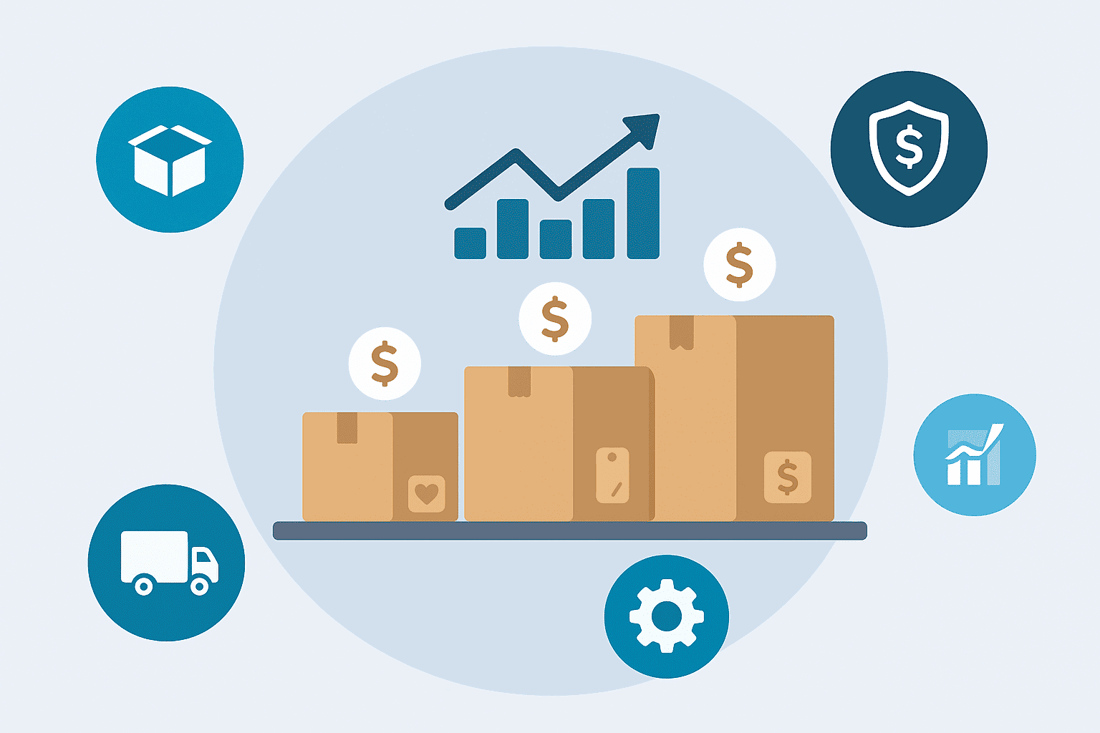
To understand how fulfillment costs vary by product type, let’s look at three examples: a small, medium, and large item shipped through a 3PL provider.
|
Product type |
Example item |
Dimensions |
Weight |
Monthly units shipped |
|
Small |
Phone case |
6 × 4 × 1 in |
0.2 lb |
2,000 |
|
Medium |
Blender |
12 × 9 × 9 in |
5 lb |
500 |
|
Bulky |
Office chair |
30 × 28 × 18 in |
25 lb |
100 |
Most fulfillment centers charge separate fees for receiving, storage, pick and pack, and shipping, with rates influenced by product size and order volume.
Below is a realistic breakdown based on typical 2025 averages.
|
Cost component |
Small (per unit) |
Medium (per unit) |
Bulky (per unit) |
|
Inbound receiving |
$0.35 |
$0.60 |
$1.25 |
|
Storage |
$0.10 |
$0.45 |
$4.00 |
|
Pick and pack |
$1.75 |
$3.00 |
$7.00 |
|
Outbound shipping |
$4.00 |
$9.50 |
$30.00 |
|
Return processing |
$0.20 |
$0.40 |
$1.00 |
|
Total per unit |
$6.40 |
$13.95 |
$43.25 |
This tells us:
- Small, lightweight products scale efficiently: With low storage and shipping costs, high-volume products such as phone cases or cables work well for outsourced fulfillment.
- Medium products remain profitable with healthy margins: Moderate shipping and handling fees enable items priced between $40 and $50 to maintain a strong ROI.
- Bulky products incur the highest fulfillment costs: Storage and carrier charges rise sharply with size and dimension weight. For heavy goods like furniture, regional 3PLs or in-house fulfillment can sometimes be more cost-effective.
For heavy or oversized products, fulfillment costs can exceed $40 per order once freight and dimensional-weight charges are added.
When comparing 3PLs, always request a detailed per-SKU cost estimate like the one above. Even small differences in pick-and-pack or shipping fees can have a significant impact on your margins over time.
Four Tips to Save Money on eCommerce Fulfillment
Outsourcing fulfillment saves your business more time and frees you up to focus on more important tasks. But after seeing how much it costs to outsource fulfillment, you might think it’s not worth the effort.
Fortunately, there are several ways you can reduce your fulfillment costs and run a tighter eCommerce business in the process. Follow these 4 tips to reduce how much you spend on fulfillment.
1 - Unlock volume discounts
Fulfillment centers are ideal for dropshippers who have high order volumes. This means that if you play your cards right, you can access bulk discounts that will make fulfillment worthwhile.
The more you order from a fulfillment center, the less you pay in per-unit or per-order fulfillment costs. Volume discounts significantly reduce these costs, too: getting a 15% discount for fulfilling bulk inventory is not uncommon. Some 3PLs will even give you a discount on pallet storage and pick and pack fees in exchange for bulk orders.
2 - Negotiate better contract terms
Want better savings on your fulfillment costs? Negotiate them! Always try to negotiate your fulfillment contract.
You have more bargaining power the longer you’ve been with a fulfillment provider. You can also score better terms if you lock into a longer-term contract. Just keep in mind that this will bond you to the fulfillment center for longer, so think carefully before signing on the dotted line.
3 - Avoid hidden costs
Don’t pay more than you need to. Be on the lookout for these hidden fulfillment costs:
- Integration costs: You need systems that talk to your 3PL. After all, you don’t want to process hundreds of orders manually! Spark Shipping is the only automated solution for this. Use it to get better data, run a more transparent business, and ensure order accuracy.
- Expedited shipping: If you offer 2-day shipping to customers, your 3PL might charge extra for this service. Read the fine print to ensure you know exactly what you’re paying for.
- International orders: Are there “gotcha” fees for international shipping? This is usually added on to pay for tariffs or duties. Again, read the fine print. For this reason, you should also carefully calculate the costs of shipping to customers in foreign countries.
4 - Do the math
The last way to save money on outsourcing fulfillment is to do the math. This will help you find the best fulfillment service and understand the financial benefits of outsourcing.
This means figuring out:
- How much inventory do you need to store, in terms of either units or square feet?
- Your average number of orders every month to estimate pick, pack, and ship costs.
- 3PL pricing (their fees and if they charge by unit, space, hour, etc.).
From here, add everything up to see approximately how much your total fulfillment costs will be monthly.
Of course, figuring out exactly how much you’ll spend when you outsource is hard. It depends greatly on the fulfillment center, your business, products, customers, and more.
Compare outsourcing costs to how much it would cost for you to do fulfillment internally, if it’s more efficient (or cheaper) to handle orders, storage, and shipping yourself, more power to you.
Sometimes the numbers will work out in favor of outsourcing, and other times they won’t.
The point is that you should always calculate fulfillment costs to see if outsourcing is wise for your eCommerce business.
Fulfillment Cost FAQs
How much do fulfillment services cost per order?
Pick-and-pack fulfillment typically runs $0.75–$3.50 per item or $2–$5 per order, on top of shipping. Shipping is usually the biggest line item, though most fulfillment companies ship for 10%–30% less than standard retail rates thanks to negotiated carrier discounts.
What fees do fulfillment centers charge?
Expect up to eight fee categories: initial setup, intake ($35–$60/hour or $0.30–$0.50/unit), storage ($10–$25 per pallet or $0.50–$0.75 per cubic foot monthly), pick-and-pack, shipping, returns, kitting, and account management. Always ask a 3PL for its full fee schedule before signing.
How can I reduce fulfillment costs?
Unlock volume discounts as you grow, negotiate contract terms (especially storage and minimums), watch for hidden fees, and do the per-order math before committing. If you dropship, you can skip warehousing costs entirely—see our guides to fulfilling dropship orders and automated order fulfillment, or connect your stack with a 3PL integration.
The Bottom Line
Customers are shopping online more than ever. But most of them are ignorant of the work it takes to put a product in their hands! As a dropshipper, you’re part of an intricate system that gets products from point A all the way to point Z. Know what to expect from your 3PL if you choose to outsource fulfillment. You can also slash your fulfillment costs with a few smart tricks to see better ROI.
However, we know that fulfillment is only half of the puzzle. Spark Shipping’s system automatically sends orders to your fulfillment center. We’re one of the only eCommerce automation solutions with intelligent order routing, so you can map your products to multiple vendors as needed.
Ready to save more time? Try Spark Shipping now.